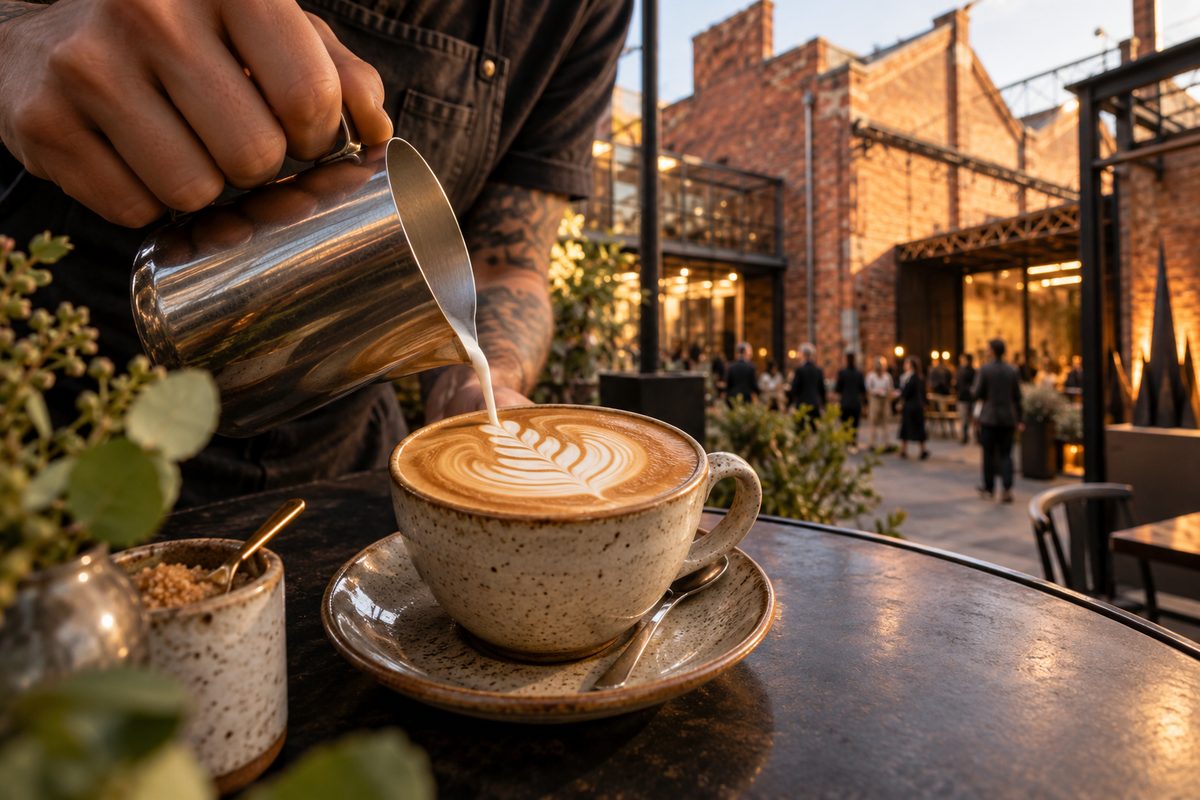
Coffee Near Malthouse Theatre
The closest coffee to Malthouse Theatre is inside the building itself, at the Malthouse Café and Bar, and your next best options are a short walk away along Sturt Street, Southbank Boulevard and St Kilda Road. Which one suits you depends on two things: what time you arrive and how much time you have before the doors open. This guide from Southbank by the River covers the coffee decision for a Malthouse visit only. It does not try to rank every café in Southbank, Victoria.
The Malthouse sits at 113 Sturt Street, at the southern end of the Melbourne Arts Precinct. That location matters. It is a few minutes further from the river and the CBD than Arts Centre Melbourne, so the cafés most people picture when they think of Southbank are not right outside the door. Plan around that and your coffee will be easy. Ignore it and you can end up walking past closed shutters ten minutes before curtain.
Why is the café inside the building usually the best first stop?
For most theatregoers, the Malthouse Café and Bar is the right answer because it removes the travel risk. You arrive, you collect your tickets, you get a coffee and you are already where you need to be. Nobody misses the start of a show because the queue was inside the venue.
The café and bar is set up for theatre timing. It serves coffee and food before performances and becomes a bar in the evening, with drinks and a place to sit before and after the show. It is also open to people who are not seeing a show, which makes it useful if you are visiting the galleries next door.
Opening hours change with the performance program. A quiet week with no shows can mean shorter hours. A busy season can mean the bar stays open late. Check the Malthouse website on the day of your visit rather than relying on hours you saw months ago.
One point most guides miss: the café inside a theatre fills up in waves. The busiest window is roughly the half hour before a show starts. If you want a calm coffee and a seat, arrive 45 minutes or more before curtain. If you only want a takeaway, the line moves quickly once the bar staff shift into pre-show mode.
When is coffee near the Malthouse hard to find?
Coffee gets scarce in the evening. This is the single biggest planning problem for Malthouse visitors, and it catches out people who are new to Melbourne.
Melbourne coffee culture is built around the morning and the early afternoon. Many independent specialty coffee cafés open early for office workers and close somewhere between 2pm and 4pm. By the time an evening show is approaching, a lot of the best espresso machines in Southbank have already been cleaned and switched off.
That gives you a simple rule:
- Matinee or daytime visit: you have plenty of choice. Walk to a dedicated specialty café first, then head to the theatre.
- Evening show: expect venue cafés, hotel lobbies, restaurants and late-opening chains to be your main options. The Malthouse Café and Bar is usually the most reliable of these for your venue.
Weekends shift the pattern again. Some weekday cafés near offices close on Saturday and Sunday, while others run shorter weekend hours. If your heart is set on a particular café, look up its hours on the same day. Google listings are not always current, so the café's own website or social pages are a safer check.
Where do you walk if you want specialty coffee instead?
Think about the area in directions rather than a list of names. Cafés open, close and change owners often in Southbank. The walking routes from the Malthouse stay the same.
North along Sturt Street toward Southbank Boulevard
Head out the front of the Malthouse and walk north up Sturt Street. You pass the Australian Centre for Contemporary Art, the large rust-coloured building right next door. Keep going and you reach Southbank Boulevard and the Melbourne Recital Centre. This stretch has the most apartment and office buildings close to the theatre, which means a steady spread of ground-floor cafés.
It is the best route for a quick pre-show coffee. You can be there and back inside 15 minutes, including the order.
East toward Arts Centre Melbourne and St Kilda Road
Walk east and you reach Arts Centre Melbourne and the wide avenue of St Kilda Road. The Arts Centre has its own food and drink outlets that serve its theatres and concert halls. Like the Malthouse, their hours follow the performance schedule, so they are more likely to be open around evening show times than a typical daytime café.
This route also takes you past the Faculty of Fine Arts and Music, University of Melbourne, the campus that includes the Victorian College of the Arts. Student-heavy areas tend to support cheaper, faster coffee during semester. Expect those spots to be busiest between classes and quieter during university breaks.
Toward the river and the CBD
If you have 30 minutes or more, you can walk toward the Yarra and over to Flinders Street. The CBD has the deepest choice of specialty coffee in the city. The catch is time. Allow roughly 15 minutes each way on foot from the Malthouse to Flinders Street Station, more if you are walking with a group or in heels. This option makes sense if you are already coming from the city, not as a detour from the theatre.
Don't confuse St Kilda Road with St Kilda
Visitors sometimes see "St Kilda Road" on a map and assume the beachside suburb is nearby. St Kilda, Victoria is several kilometres south, at the far end of that road. It has a strong café scene of its own, but it is a tram ride away, not a coffee stop on the way to the Malthouse. For pre-show coffee, stay within the arts precinct.
What should you order before a show?
Order something you can finish in ten minutes. Theatres in the Malthouse generally do not allow hot drinks into the auditorium, so a coffee you are still nursing when the doors open usually ends up in the bin. Ask the front-of-house staff on the day, as rules can vary by show and space.
A flat white is the safest choice. It is a small, strong milk coffee with a thin layer of silky milk, and it is the drink most Melbourne cafés make best. Because it is smaller than a latte, you finish it faster. If you want less volume again, a piccolo or a short macchiato works the same way.
Cold brew coffee is a good pick on hot days. It is made by steeping ground coffee in cold water for many hours, which gives a smooth, less sharp flavour. It is also quick to serve because it is made in advance. The trade-off is caffeine. Cold brew can be strong, and the amount varies a lot between cafés. If you are sensitive to caffeine and seeing a late show, ask the barista how strong theirs is, or choose a decaf flat white instead.
Timing your caffeine matters more than most people think. Caffeine takes around 30 to 60 minutes to have its full effect. A coffee drunk right before a 7.30pm show will be working hardest in the middle of the performance, which is what you want for a long play. The flip side is sleep. If you struggle to sleep after evening coffee, have your last one before 6pm or switch to decaf.
What about the interval?
Plan for a short or busy interval. Intervals are often around 15 to 20 minutes, and the bar gets a sudden rush. If you want a coffee at interval, check whether the bar takes pre-orders before the show starts. Many theatre bars do this for drinks, and it saves you standing in line while the bell rings.
What does a former brewery have to do with coffee?
More than you might expect. The Malthouse building was originally a malting works for Carlton & United Breweries. Barley was soaked, sprouted and then dried and toasted in kilns to make malt for beer. The theatre company moved in and converted the industrial site into performance spaces in the 1990s, keeping much of the original brick structure.
Malting and coffee roasting follow the same basic idea. Heat changes the colour and flavour of a raw seed or grain. Lightly kilned malt tastes bready and sweet. Darker malt tastes like toast or chocolate. Coffee behaves in a similar way. A light roast keeps more fruity and bright flavours from the bean. A darker roast brings out bitterness and deeper chocolate notes that cut through milk.
This helps you order. If you are having a flat white, a medium to darker roast usually tastes fuller with milk. If you are drinking black coffee or a filter, ask for a lighter single-origin roast. Specialty cafés will happily tell you what they are using that day, and many list it on a small board near the till.
It also tells you something about the area. Southbank was an industrial district long before it was an arts precinct. The galleries, theatres and apartments are relatively new uses for old land, and the café scene is still filling in around them. That is part of why coffee near the Malthouse feels thinner than coffee in older inner suburbs.
Who else will be chasing coffee at the same time?
Knowing the local crowd helps you avoid the worst queues.
- Weekday mornings: office workers and residents from the Southbank Boulevard towers. Cafés are busy from about 7.30am to 9.30am.
- Weekday middays: students from the Faculty of Fine Arts and Music and gallery staff. Lunch rushes hit between noon and 1.30pm.
- Weekend afternoons: gallery visitors heading to the Australian Centre for Contemporary Art and the wider precinct. Matinee audiences add to this.
- Weekday evenings: theatre and concert audiences from the Malthouse, the Melbourne Recital Centre and Arts Centre Melbourne, often all arriving within the same hour.
The evening overlap is the one to watch. When several venues in the precinct have shows starting at a similar time, every nearby bar and café with coffee gets busy at once. On those nights, getting your coffee inside your own venue early is the calmest option.
How do you get to the Malthouse with coffee in hand?
Most people arrive by tram along St Kilda Road and walk west, or walk south from Flinders Street Station across Princes Bridge. Both routes pass Arts Centre Melbourne, which makes it a natural place to grab coffee on the way if its outlets are open.
If you are driving, allow extra time for parking. Every minute spent finding a park is a minute taken from your coffee window. Arriving on foot or by tram gives you more control over timing.
Keep a lid on your takeaway cup if you are walking along Sturt Street. The footpaths are wide but busy at show times, and a spill on the way in is an avoidable start to the night.
Your coffee plan for a Malthouse visit
The one thing to do: decide where your coffee comes from before you leave home, based on your show time. A matinee lets you chase specialty coffee. An evening show means planning around the venue café.
Here is how to put that into practice:
- Check the show time and the Malthouse Café and Bar hours on the Malthouse website on the day.
- For a daytime visit, walk north up Sturt Street toward Southbank Boulevard and choose a specialty café there. Allow 15 minutes for the round trip.
- For an evening show, arrive at least 45 minutes early and get your coffee inside the venue before the pre-show rush.
- Order a flat white or another small drink you can finish before the doors open.
- Pre-order interval drinks at the bar if that option is offered.
- If late coffee keeps you awake, switch to decaf after 6pm.
For more on eating, drinking and getting around the arts precinct, explore the rest of Southbank by the River.
The Malthouse Theatre sits in Southbank in a converted industrial building that once served as a malt house for Carlton & United Breweries, and that brewing history still shapes the brick-and-timber character of the precinct. If you're looking for coffee near Malthouse Theatre, it helps to plan ahead. Cafés and bars in and around the arts precinct on Sturt Street mean you can grab a pre-show flat white or a quick espresso at interval without going far from the venue.