Buxton Contemporary Visitor Guide
Buxton Contemporary is a free contemporary art museum on Dodds Street in Southbank, run by the University of Melbourne, and most people see the whole building in about an hour. It opened in March 2018 to hold the collection that property developer Michael Buxton gave to the university, along with funding for the building itself. It sits inside the Victorian College of the Arts campus, a short walk from the National Gallery of Victoria and the Australian Centre for Contemporary Art. This guide covers what makes it different from those bigger neighbours, how to find the door, what you will see inside and how to fit it into an afternoon in Southbank, Victoria.
What is Buxton Contemporary, and why is it not just another gallery?
It is a university art museum built around a single private collection of Australian contemporary art. That is a rare thing in Melbourne. The collection, known as the Michael Buxton Collection, holds more than 350 works by Australian artists made from the 1980s onward. Buxton gave it to the University of Melbourne in 2014 with a condition that matters to visitors: the works were to be shown, studied and shared rather than left in storage.
The names in the collection explain why people make the trip. Howard Arkley is there, with his airbrushed suburban houses in lurid pinks and greens. Bill Henson is there, with his dark, cinematic photographs of twilight and youth. Patricia Piccinini is there, with the silicone creatures that look half human and half something else. Alongside them sit Tracey Moffatt, Peter Booth, Mike Parr, Callum Morton, Ricky Swallow, Brook Andrew and Juan Davila. Buxton collected deeply rather than widely. He followed a short list of artists over decades, buying several works from each, so the collection shows how an artist changed over time rather than offering one sample piece.
The museum belongs to the Faculty of Fine Arts and Music, University of Melbourne. That changes how it feels. It is a teaching museum. Students pass through the building on the way to class. Exhibitions are often shaped by academic staff and curators who also teach. The result is quieter and more thoughtful than a blockbuster, and the wall text tends to assume you are curious rather than lost.
Where exactly is it, and how do you find the entrance?
The building stands on the corner of Dodds Street and Southbank Boulevard, at the southern edge of the Melbourne Arts Precinct. If you are walking from the river, you pass the Arts Centre spire and the National Gallery of Victoria on St Kilda Road, then turn right into Southbank Boulevard. The boulevard was rebuilt by the City of Melbourne as a long linear park, so the walk down is green and easy. Buxton Contemporary appears on your left after a few minutes, just before the Victorian College of the Arts buildings.
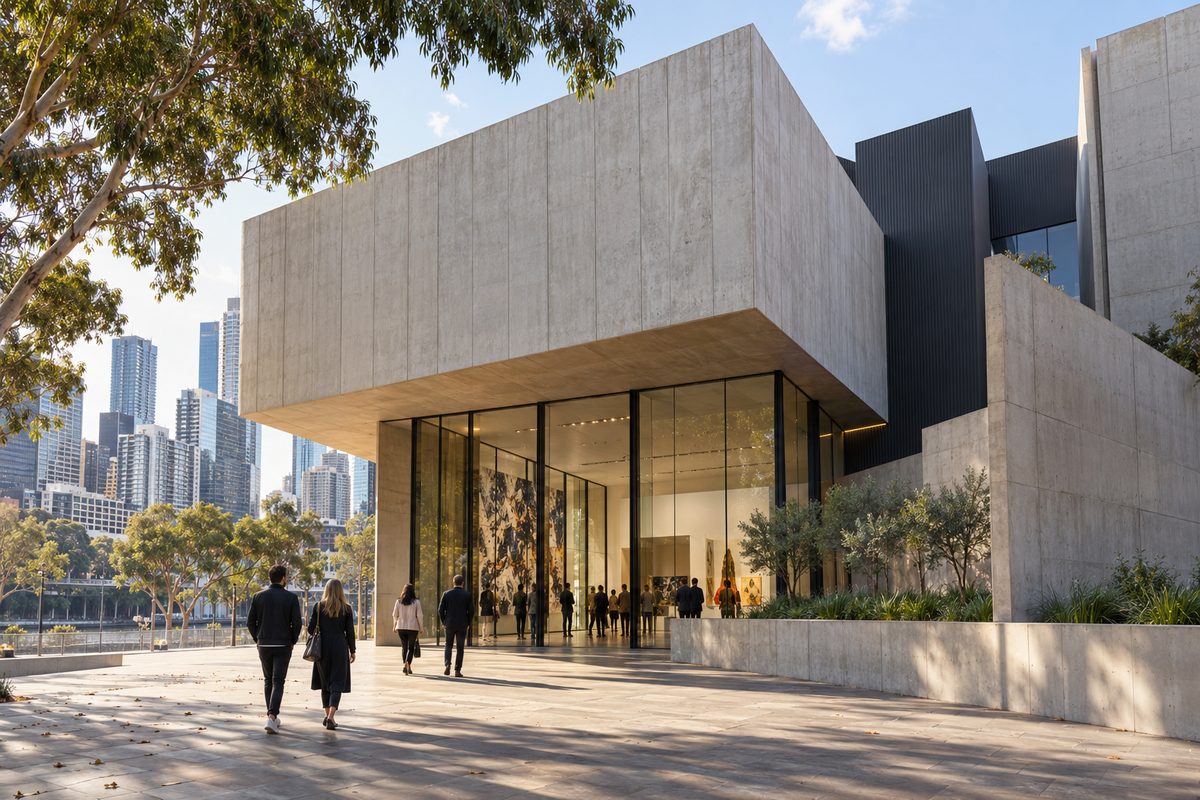
Fender Katsalidis Architects designed the building. The same firm did Eureka Tower and Australia 108 further along Southbank, so this is a change of scale for them. Buxton Contemporary is low and angular, with a dark facade that reads more like a studio than a civic monument. The main entrance faces the corner. Look for the glass doors and the museum signage rather than the campus gates, because the two sit close together and first-time visitors sometimes wander into the college instead.
From Flinders Street railway station, the walk takes 15 to 20 minutes. Cross Princes Bridge, keep going along St Kilda Road past the NGV water wall, then turn right at Southbank Boulevard. If you would rather ride, any tram heading south on St Kilda Road stops within a few minutes of the museum. Tram route 1 along Sturt Street stops closer still. One catch: the Free Tram Zone ends at Flinders Street, so you need a myki or a contactless card for the short hop down St Kilda Road. Driving is possible, with paid parking under the Arts Centre and at the NGV, but on a weekday the tram beats the car every time.
What does it cost and when is it open?
Entry is free, and there is no booking required for general admission. The museum opens Wednesday to Sunday from 11am to 5pm and closes on Mondays and Tuesdays. It also closes on most public holidays.
The detail that catches people out is the gap between exhibitions. Buxton Contemporary is not a permanent-hang museum. When one show comes down and the next goes up, the whole building closes for several weeks. There is no partial opening and no collection room you can fall back on. Check the current exhibition dates on the museum website before you walk down Southbank Boulevard. A closed door after a 20-minute walk from the station is the single most common complaint about the place, and it is entirely avoidable.
What will you actually see inside?
Expect two levels of galleries and one exhibition at a time. The ground floor holds a large flexible gallery with high ceilings built for big installations and video. Upstairs are smaller, more intimate rooms suited to painting and photography. The whole visit flows in a loop, so you will not miss a room by accident.
Exhibitions change two or three times a year. Some draw purely from the Buxton collection and arrange it around a theme, such as the body, the suburb or the night. Others pair collection works with new commissions from living artists, often including graduates of the Victorian College of the Arts. Because the program rotates, you cannot count on seeing a specific Arkley or Henson on a given day. Treat the collection list as a guide to the kind of art you will meet, not a checklist of guaranteed works.
The building was designed with moving image in mind. Several galleries can be blacked out fully, which matters for video artists who want control over light and sound. If a show includes film works, allow extra time. A 20-minute video loop deserves to be watched, and the seating is comfortable enough to do it.
Photography without flash is normally permitted for personal use, though individual works may be marked otherwise. Bags larger than a daypack can be left at the front desk. There is no cafe inside the museum, which pushes you back out to Southbank Boulevard or Sturt Street for coffee. That is a feature rather than a flaw, because it keeps the building focused on the art.
How does the university connection change the visit?
In three practical ways. First, the crowd is small. Even on a Saturday, the galleries rarely feel busy, because most tourists stop at the NGV and never reach Dodds Street. You can stand in front of a Piccinini sculpture for as long as you like.
Second, the public program is strong for a museum of its size. Artist talks, panel discussions and student-led tours run through each exhibition, and most are free. They are often listed on the Faculty of Fine Arts and Music events page as well as the museum site, so check both if you want to time your visit around one.
Third, the front-of-house staff are frequently postgraduate students or recent graduates. Ask them about the work. In a bigger institution you might get a polite shrug. Here you are likely to get a real conversation from someone who has written an essay on the artist.
How does it compare with ACCA and the NGV for a short visit?
These three sit within ten minutes of each other, and each does a different job. The National Gallery of Victoria on St Kilda Road is an encyclopaedic art museum. It covers everything from ancient ceramics to European painting to fashion, and you could spend a full day there. The Australian Centre for Contemporary Art on Sturt Street is a kunsthalle. It owns no collection and commissions new work for every show, so what you see is usually brand new and sometimes unfinished in feel.
Buxton Contemporary sits between them. It has a collection, so there is a sense of history and depth. It changes its program, so there is always something new. It is Australian in focus, which neither of the other two can claim across their full programs. If you have one hour and want Australian contemporary art with no entry fee, Buxton is the pick. If you have three hours, do Buxton and ACCA together, because they share a corner of the precinct and the contrast between a collection show and a commissioned show is instructive. If you have a whole day, the NGV comes first and the other two follow in the afternoon.
The scale difference is worth stating plainly. The NGV can be exhausting. ACCA can be demanding. Buxton Contemporary is neither. It is the most approachable of the three for a visitor who is unsure about contemporary art and does not want to commit a full day to finding out.
How do you build a Southbank art walk around it?
Start at Flinders Street railway station around 11am. Cross Princes Bridge and spend an hour at NGV International, keeping to one or two floors rather than the whole building. Walk down St Kilda Road, cut across to Sturt Street and visit ACCA, which takes 45 minutes to an hour. Continue to the corner of Dodds Street and finish at Buxton Contemporary. By 3pm you have seen three very different institutions on foot without once crossing a main road at a hurry.
Head back along Southbank Boulevard, where the linear park has lawns, seating and a handful of cafes on the Sturt Street side. From there it is a ten-minute walk to the river for an early dinner. For venue picks by occasion along the water, the guides at Southbank by the River cover the riverside strip, the precinct cafes and the laneways behind the casino separately, so you can match the meal to how much energy you have left.
One current note affects this route. The Melbourne Arts Precinct Transformation is under construction along Southbank Boulevard and Sturt Street, including the site of the future NGV Contemporary. Hoardings and pedestrian detours shift as the works progress. Follow the signed paths rather than your map, and allow five extra minutes between ACCA and Buxton.
What do most first-time visitors get wrong?
They expect a permanent collection display. There is none. The museum is a rotating exhibition space built on a collection, and the show on the day is the whole experience. Read the exhibition description before you go so you know whether it is a collection hang or a commissioned project.
They turn up on a Monday or Tuesday. The museum is closed both days every week, and closed between shows. This single fact accounts for most wasted trips.
They skip the upstairs rooms. The ground floor gallery is large and dramatic, and some visitors loop it and leave. The smaller upstairs galleries are where the paintings and photographs usually hang, including the works by Howard Arkley and Bill Henson when they are on display. Take the stairs.
They treat it as a side trip from the NGV. It deserves its own place in the plan. The art is as strong as anything in the NGV's Australian galleries, and the viewing conditions are better, because you are often alone with it.
They miss the building. Fender Katsalidis Architects gave the museum a carefully controlled sequence of light and dark rooms, and the way the galleries open onto each other is part of the design. Slow down in the transitions between spaces rather than rushing from work to work.
Your Buxton Contemporary plan
- Check the museum website for the current exhibition and confirm it is open on your chosen day. Wednesday to Sunday, 11am to 5pm, with full closures between shows.
- Travel by foot from Flinders Street railway station or by tram down St Kilda Road. Carry a myki or contactless card for the tram, because the free zone ends at Flinders Street.
- Allow 60 to 90 minutes inside, longer if video work is on show.
- Pair it with the Australian Centre for Contemporary Art on Sturt Street, which is five minutes away and runs on the same free-entry model.
- Ask the front desk about talks and tours during your visit, and ask staff about the work in front of you.
- Finish on Southbank Boulevard or the river for food, using the occasion-based guides on Southbank by the River to pick a venue.
Before anything else, open the exhibition page and read what is on. That one step turns Buxton Contemporary from a gamble into the most rewarding free hour of art in Southbank.