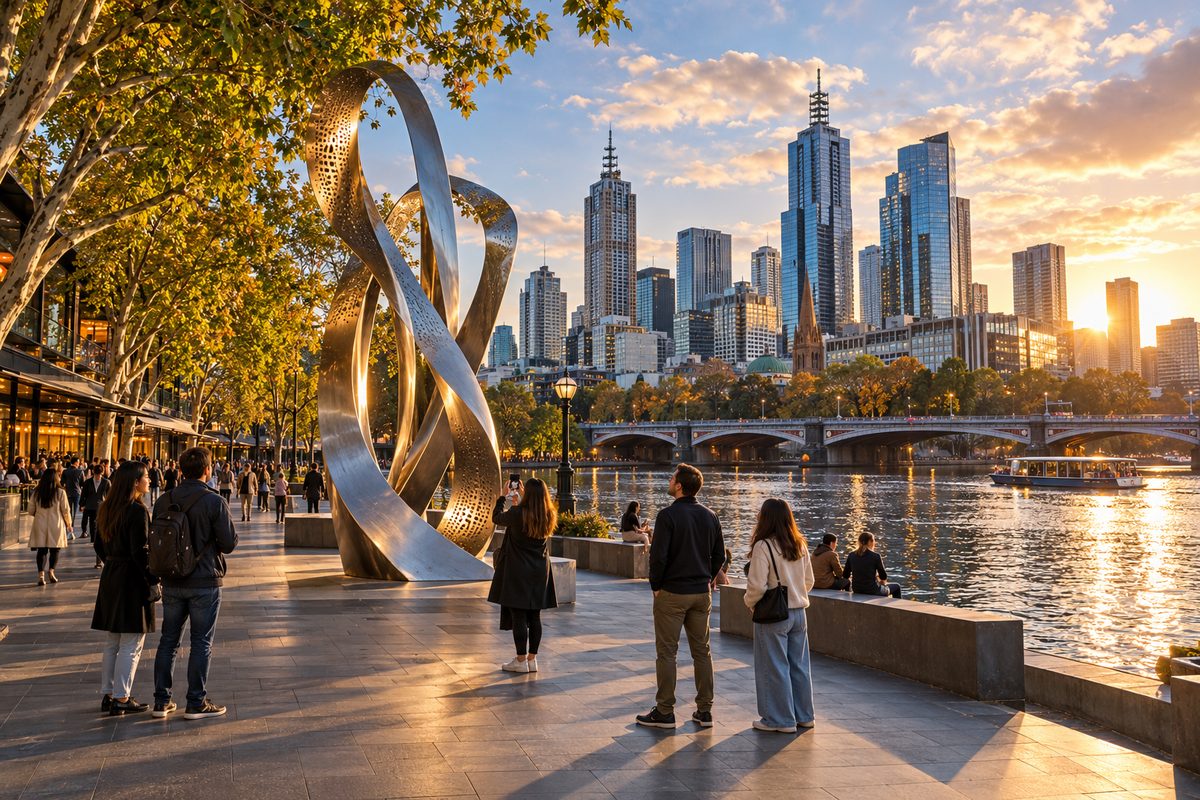
Southbank Melbourne Public Art Guide
Southbank holds the densest cluster of free public art in Melbourne, and almost all of it sits within a 20 minute walk between the Yarra River and Sturt Street. The sculptures on the promenade, the works outside Arts Centre Melbourne and the National Gallery of Victoria, and the pieces scattered around the Melbourne Arts Precinct cost nothing to see. This guide maps the works worth your time, explains why they are where they are, and gives you a route that covers them in a morning. For the wider neighbourhood, start at Southbank by the River.
Where does the public art start?
Start at the water. The Southbank Promenade runs along the south side of the Yarra River from Princes Bridge to Crown Melbourne, and it carries the works most visitors see first.
At Southgate, look for Ophelia by Deborah Halpern. It is a mosaic figure in bright tiles, installed in 1992, and it has become the unofficial mascot of the riverfront. Halpern also made Angel, which once stood in the moat at the National Gallery of Victoria. Many guides still place Angel in Southbank. It moved to Birrarung Marr on the north bank in 2006. If you want to see it, cross the river.
Walk west toward Queens Bridge and you reach Constellation by Bruce Armstrong and Geoffrey Bartlett, a tall steel and timber work from 1997 that reads best from a distance. Keep going and you hit Sandridge Bridge, the old rail bridge turned pedestrian crossing. On it stands The Travellers by Nadim Karam: ten large steel figures, nine of which glide along the bridge on tracks at set times. Each figure represents a wave of migration to Victoria. The stationary figure, Gayip, represents the Aboriginal people of the land. Timetables for the moving figures change, so check the City of Melbourne website before you plan around them.
Crown Melbourne is the western end of the promenade. Its contribution to public art is the row of gas brigade towers along the river, which shoot fireballs into the air on the hour after dark. It is theatre rather than sculpture, but it draws the biggest crowd of anything on this list and it is free.
What should you see around Arts Centre Melbourne?
The lawn beside the Theatres Building, between Hamer Hall and the spire, holds the most important sculpture in Southbank, Victoria. Forward Surge by Inge King was completed in 1974 and installed in 1981. Four black steel waves rise higher than a person. King was a German-born sculptor who shaped modernist public art in Australia, and this is her best known work. Walk through it rather than around it. The curves were designed to be entered.
Arts Centre Melbourne itself works as public art. The spire, redesigned in the 1990s, is lit at night and visible from most of the river. Inside, the foyers hold a large collection of Australian paintings and sculpture that you can view without a ticket during opening hours. The Australian Music Vault on the ground level is also free.
Next door on St Kilda Road is the National Gallery of Victoria, known as NGV International. Before you go inside, note Henry Moore's Draped Seated Woman on the forecourt. Then walk through the water wall entrance. The Great Hall ceiling by Leonard French is the largest stained glass ceiling in the world, and lying on the floor beneath it is encouraged. The permanent collection is free. The Grollo Equiset Garden at the rear holds a rotating set of outdoor sculptures and is often empty on weekday mornings.
Behind the Arts Centre, across Linlithgow Avenue, the Sidney Myer Music Bowl sits in Kings Domain. Opened in 1959, its tensioned canopy was ahead of its time and the structure is heritage listed. Outside concert days you can walk the lawn and look at it as architecture. Kings Domain also holds several bronze figures and memorials, which makes it a natural extension of the walk if you have time.
Why is Sturt Street the quiet heart of the precinct?
Most visitors never leave the river. The best contemporary art in Southbank is five minutes inland.
The Australian Centre for Contemporary Art, known as ACCA, sits on Sturt Street in a rusted steel building by Wood Marsh. Entry is free and the exhibitions change several times a year. The building is itself the artwork most people photograph. Outside it stands Vault by Ron Robertson-Swann, the yellow steel sculpture Melburnians nicknamed the Yellow Peril. Installed in City Square in 1980, it caused a public argument so heated that the council removed it within a year. It was shunted to Batman Park, then moved to ACCA in 2002. Standing in front of it now, the fuss is hard to understand, which is the point.
Across the street, the Melbourne Recital Centre and the Southbank Theatre share a block. The Recital Centre's honeycomb facade by ARM Architecture glows at night. The foyer is open to the public and often hosts free performances. The Southbank Theatre, home of Melbourne Theatre Company, wears a web of white steel tubes that reads as sculpture from the footpath.
Further along Sturt Street and Dodds Street is the Southbank campus of the Faculty of Fine Arts and Music, University of Melbourne, which includes the Victorian College of the Arts. Student exhibitions run through the year in the campus galleries and are open to anyone who walks in. Buxton Contemporary, on the corner of Dodds Street and Southbank Boulevard, is the university's museum of contemporary art. It is free and shows Australian work from the Buxton collection alongside commissioned exhibitions. Check its website for current hours, which differ from the larger galleries.
Southbank Boulevard itself has changed. The City of Melbourne converted much of the road into linear parkland, with new lawns, trees and seating between St Kilda Road and the Recital Centre. The council manages a public art programme across the municipality, and the boulevard is where new commissions in this precinct tend to appear first. Walk it slowly and read the plaques.
Does Southbank have street art?
Not much, and anyone who tells you otherwise is confusing it with the city centre. The lanes and arcades of Melbourne that made the city famous for street art, Hosier Lane and AC/DC Lane among them, sit on the north side of the river. From Southgate, Hosier Lane is a ten minute walk over Princes Bridge and up Flinders Street.
Southbank's version is smaller and more scattered. Painted walls appear around the VCA campus on Dodds Street, along the laneways behind Sturt Street, and under the rail bridges toward Southbank Boulevard. These change often because students and visiting artists repaint them. They are worth a detour if you are already on Sturt Street, but do not build a trip around them.
The exception is the Eureka Tower on Riverside Quay. Richard Stringer's Queen Bee installation, a cluster of golden bees fixed to the facade near the City Road entrance, counts as public art even though it sits on a private tower. Look up before you look for a laneway.
What is changing with the Melbourne Arts Precinct transformation?
The largest cultural building project in Australia is under way on Southbank Boulevard. The Fox: NGV Contemporary is being built on the former Carlton and United Breweries site beside ACCA and is planned to open in 2028. Around it, an 18,000 square metre public garden called Laak Boorndap will link the new gallery to the existing NGV International and Arts Centre Melbourne.
For a visitor today this means hoardings and construction noise around Southbank Boulevard and Sturt Street. It also means the precinct will roughly double its free public space within a few years. If you visit now, treat the construction site as a marker of where the walk will extend. Arts Centre Melbourne is also undergoing works on its Theatres Building, so some entrances move. Check the venue websites the day before you go.
How do you plan a walking route?
This loop covers every work above in about two and a half hours at a steady pace, longer if you go inside the galleries. It starts and ends at Flinders Street Station so you can arrive by train or tram.
- Cross Princes Bridge to Southgate. See Ophelia and the river views.
- Walk west along the promenade past Constellation to Sandridge Bridge. Walk out onto the bridge for The Travellers.
- Continue to Crown Melbourne if it is evening for the gas brigades. Otherwise turn back.
- Return to Southgate and climb to St Kilda Road. Walk through the Arts Centre lawn to Forward Surge.
- Enter NGV International through the water wall. See the Great Hall ceiling and the sculpture garden.
- Exit onto Southbank Boulevard and walk to Sturt Street. See Vault, then go into ACCA.
- Cross to the Melbourne Recital Centre foyer, then walk along Dodds Street past the VCA to Buxton Contemporary.
- Return along Southbank Boulevard to St Kilda Road. If you have energy left, cross into Kings Domain for the Sidney Myer Music Bowl.
Weekday mornings are quietest. Saturday afternoons bring wedding photographers to the Arts Centre lawn and crowds to Southgate. ACCA and Buxton Contemporary close on Mondays in most seasons, so check before you commit to a Monday.
What do most guides get wrong?
They stop at the river. The promenade is pleasant, but the works there are decorative. The pieces that matter to the history of Australian art, Forward Surge and Vault, sit away from the water and get a fraction of the foot traffic.
They list galleries without saying which parts are free. NGV International charges for major touring exhibitions but the permanent collection, the Great Hall and the garden cost nothing. ACCA and Buxton Contemporary are always free. Arts Centre Melbourne's foyer collection is free. You can see a full day of contemporary art in Southbank without paying for a ticket.
They ignore the buildings. In this precinct the architecture does as much work as the sculpture. The ACCA shell, the Recital Centre facade and the Arts Centre spire were all designed to be seen from the street, and they change completely between day and night. A second visit after dark is a different walk.
They treat Southbank and South Bank as the same place. South Bank is a parkland in Brisbane. Southbank is the suburb on the south side of the Yarra River in Melbourne. Search results mix the two constantly, and an itinerary built from the wrong city will send you to a lagoon that does not exist here.
Your next steps
Pick a weekday morning and follow the loop above from Flinders Street Station. Before you leave, check three things online: the current exhibition at ACCA, the opening days for Buxton Contemporary, and the running times for The Travellers on Sandridge Bridge. Wear shoes you can walk five kilometres in. Give Forward Surge and Vault ten minutes each rather than a photo and a glance. Then come back after dark once, when the gas brigades fire and the precinct buildings light up, and you will have seen Southbank's public art the way it was meant to be seen. For where to eat and how to get there, use the neighbourhood guides at Southbank by the River.