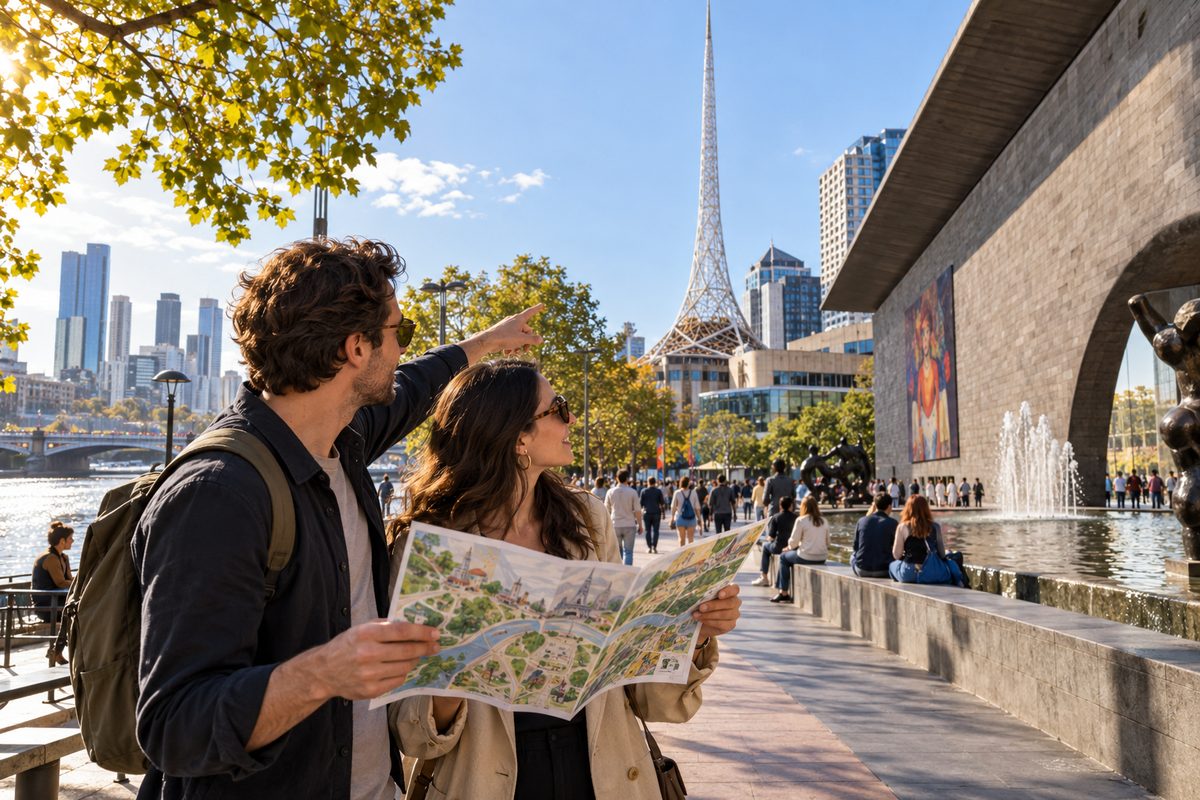
Planning an Arts Day in Southbank Melbourne
Build your arts day in Southbank Melbourne around one booked performance, then fill the hours before and after with the free galleries, foyers and riverside walks that sit within ten minutes of it. The Melbourne Arts Precinct packs more venues into a few blocks than anywhere else in the country, which is the problem as much as the appeal. Visitors try to do everything and end the day having rushed past most of it. One anchor event gives the day a fixed time. Everything else slots in around it, and because the venues sit so close together, you can walk the whole plan without a tram or a car park. This guide from Southbank by the River covers how the precinct fits together, what is free, how to order the day, and the mistakes that waste the most time.
Why should one booked event anchor the whole day?
A ticketed show is the only part of the day you cannot move. A 7.30pm concert at Hamer Hall, Melbourne's main concert hall, fixes your evening. A 1pm matinee at Southbank Theatre fixes your midday. Once that time is set, the rest of the plan becomes simple arithmetic: how many hours do you have before, and how many after.
Without an anchor, people drift. They arrive at the National Gallery of Victoria at 11am, stay longer than planned, and discover that the exhibition they wanted at the Australian Centre for Contemporary Art closes at 5pm just as they reach Sturt Street. A booked show forces decisions early, and early decisions are what make a day in Southbank, Victoria feel relaxed instead of frantic.
Book the anchor first. Pick a venue below, check its program, and buy the ticket before you plan anything else.
How do the venues sit on the map?
The precinct runs along two streets. St Kilda Road carries the big public buildings. Sturt Street, one block west, carries the performing arts venues. The river sits at the northern end of both.
Starting at the river and walking south:
- Arts Centre Melbourne occupies the first block of St Kilda Road beside Princes Bridge. Hamer Hall sits on the river side. The spire marks the Theatres Building, which is closed for redevelopment as part of the precinct transformation works. Productions that would normally play there have moved to other venues, so confirm the actual address on your ticket before you set out.
- NGV International, the main St Kilda Road home of the National Gallery of Victoria, is the next building south. The water wall entrance is hard to miss.
- Melbourne Recital Centre stands at the corner of Southbank Boulevard and Sturt Street, directly behind the gallery.
- Southbank Theatre, home of the Melbourne Theatre Company, is a few doors along Southbank Boulevard from the Recital Centre.
- Australian Centre for Contemporary Art sits further down Sturt Street in the rust-red steel building.
- The University of Melbourne Southbank campus fills the blocks around Sturt and Dodds Streets. It houses the Victorian College of the Arts, the Melbourne Conservatorium of Music and Buxton Contemporary, a free art museum on Dodds Street.
Two outliers matter. The Ian Potter Centre: NGV Australia is at Federation Square, across Princes Bridge on the north bank. It is still a ten minute walk from NGV International, so it belongs in a Southbank arts day even though it technically sits in the city. Crown Melbourne is a fifteen minute walk west along the river promenade, which makes it a sensible finishing point rather than a starting one.
The practical result: you can walk from Hamer Hall to ACCA in about eight minutes. Nothing in the core precinct is more than a short stroll from anything else.
What can you see for free between shows?
More than most visitors realise. General entry to the permanent collection at both National Gallery of Victoria sites costs nothing. Only the major touring exhibitions carry a ticket. That gives you two large galleries, one on each side of the river, to fill any gap in the day.
The Australian Centre for Contemporary Art is also free. It shows new commissioned work rather than a permanent collection, so each visit is different. It is closed on Mondays, which catches people out.
Buxton Contemporary on the University of Melbourne campus is free and small enough to see in forty minutes. The campus itself is worth a slow walk. Student recitals and graduate exhibitions run through the semester and are often open to the public at no cost. Check the Conservatorium and VCA event listings before your visit.
Melbourne Recital Centre runs occasional free foyer and lunchtime performances. These rarely appear in tourist guides because they are programmed close to the date, so look at the venue calendar in the week before you go.
On Sundays, the Arts Centre Melbourne market runs along the St Kilda Road forecourt from mid morning. It is a good way to spend a spare hour before a matinee.
Finally, the river itself. Southbank Promenade and the Princes Bridge approach give you a half hour walk with the city skyline across the water. It costs nothing and resets your attention between two indoor venues.
Which venue suits which kind of day?
Choose your anchor by the art form you want, because each venue serves one.
Classical and chamber music
Hamer Hall hosts the Melbourne Symphony Orchestra and large touring orchestras. The Melbourne Recital Centre is the better choice for chamber music, solo recitals and smaller ensembles. Its main hall, Elisabeth Murdoch Hall, seats around a thousand and is known for acoustics that let you hear a single cello clearly from the back row. If you want to feel close to the performers, choose the Recital Centre over Hamer Hall.
Theatre
Southbank Theatre is the main house of the Melbourne Theatre Company, which operates as a department of the University of Melbourne. The Sumner is the larger stage. The Lawler is a studio space for smaller productions. MTC seasons run most of the year, and weekday matinees are often cheaper than Saturday nights.
Visual art
Split the two NGV sites by what they hold. NGV International on St Kilda Road houses the international collection and most blockbuster exhibitions. The Ian Potter Centre: NGV Australia holds the Australian and First Nations collections. If you only have time for one, pick based on which collection you have not seen, not which is closer.
The Australian Centre for Contemporary Art and Buxton Contemporary are for people who want current work. Expect installation, video and sculpture rather than paintings on walls.
An evening finish
Crown Melbourne offers cinemas, live entertainment and late dining along the river. It suits a group that wants somewhere to keep going after a show rather than a group that wants more art.
How do you order the day so you are not backtracking?
Work in one direction along the precinct and let the anchor decide which direction that is.
For an evening anchor at Hamer Hall or the Recital Centre, start at the southern end. Begin at ACCA or Buxton Contemporary around late morning, walk north up Sturt Street, take a late lunch, spend the afternoon in NGV International, and finish at the concert hall a few minutes away. You end the day where your show is.
For a matinee anchor at Southbank Theatre, reverse it. Start at the Ian Potter Centre: NGV Australia when it opens, cross Princes Bridge, walk through NGV International, and arrive at the theatre for the 1pm start. After the show, ACCA and the university campus are a short walk south and open until late afternoon.
Two timing rules keep this working. Galleries open at 10am and close at 5pm, so put gallery time in the middle of the day and performances at the edges. And allow ninety minutes minimum for any NGV visit. People who allow an hour spend half of it in the entrance queue and the cloakroom.
When do festivals change the plan?
Two festivals rewrite the precinct calendar.
The Melbourne International Arts Festival ran each October for decades and was the biggest single event in the precinct. In 2021 it merged with White Night to become RISING, which now runs in winter, usually June. If you have read an older guide that tells you to visit in October for the Arts Festival, that advice is out of date. Winter is now the time for large scale international programming, and venues across Southbank fill quickly during those two weeks.
The Melbourne Fringe Festival still runs in spring, usually from late September into mid October. Its hub is at Trades Hall in Carlton, but Fringe shows spread across the city and often use Southbank venues. Fringe tickets are cheap, shows are short, and you can fit two or three into an evening. It is the easiest festival for building a packed arts day on a small budget.
During either festival, book the anchor weeks ahead rather than days. Also expect the free galleries to be busier, since festival visitors use them the same way you do.
What do most arts day plans get wrong?
They treat the precinct as a checklist. Six venues in one day sounds impressive and feels exhausting. Three done properly beats six done at a jog.
They forget that venues are closed when they expect them open. ACCA on Mondays. Theatres on nights with no performance. The Arts Centre Melbourne Theatres Building for the duration of its redevelopment. A two minute check of each venue website the night before prevents most wasted walks.
They book the anchor last. By the time the galleries are planned, the only remaining seats for the show are in the back corner or sold out. Reverse the order.
They assume the Ian Potter Centre: NGV Australia is somewhere in Southbank and go looking for it on St Kilda Road. It is across the river at Federation Square. Walk over Princes Bridge.
They skip the University of Melbourne campus because it does not look like a tourist destination. Its free student performances and small exhibitions are often the most memorable part of a visit precisely because nobody else is there.
And they drive. Parking in the precinct is expensive and fills on performance nights. Trams along St Kilda Road stop outside Arts Centre Melbourne, and the Free Tram Zone ends at Federation Square, a five minute walk from the precinct. Flinders Street Station is across the bridge. We cover the parking question in a separate guide, but the simple advice is to leave the car at home for an arts day.
Two sample days
Classical evening
- 11am: Australian Centre for Contemporary Art, Sturt Street. One hour.
- 12.15pm: Walk north through the University of Melbourne campus. Stop at Buxton Contemporary.
- 1.30pm: Lunch on Southbank Boulevard or the river promenade.
- 2.45pm: NGV International. Two hours.
- 5pm: Walk to the river, then an early dinner.
- 7.30pm: Concert at Hamer Hall or Melbourne Recital Centre.
Theatre matinee
- 10am: Ian Potter Centre: NGV Australia at Federation Square. Ninety minutes.
- 11.45am: Cross Princes Bridge. Quick walk through the NGV International ground floor.
- 12.30pm: Light lunch near Southbank Boulevard.
- 1pm: Melbourne Theatre Company matinee at Southbank Theatre.
- 3.45pm: Australian Centre for Contemporary Art before it closes.
- 5.30pm: Walk west along the promenade to Crown Melbourne for dinner or a film.
Your next steps
Open the program for the venue that matches the art form you want and book one show. Note its start time and the address on the ticket. Then pick two free stops from the list above that sit in the same direction of travel, check their opening days, and leave the car at home. For more on getting around the area, where to eat before a show and what else is on along the river, start at Southbank by the River.