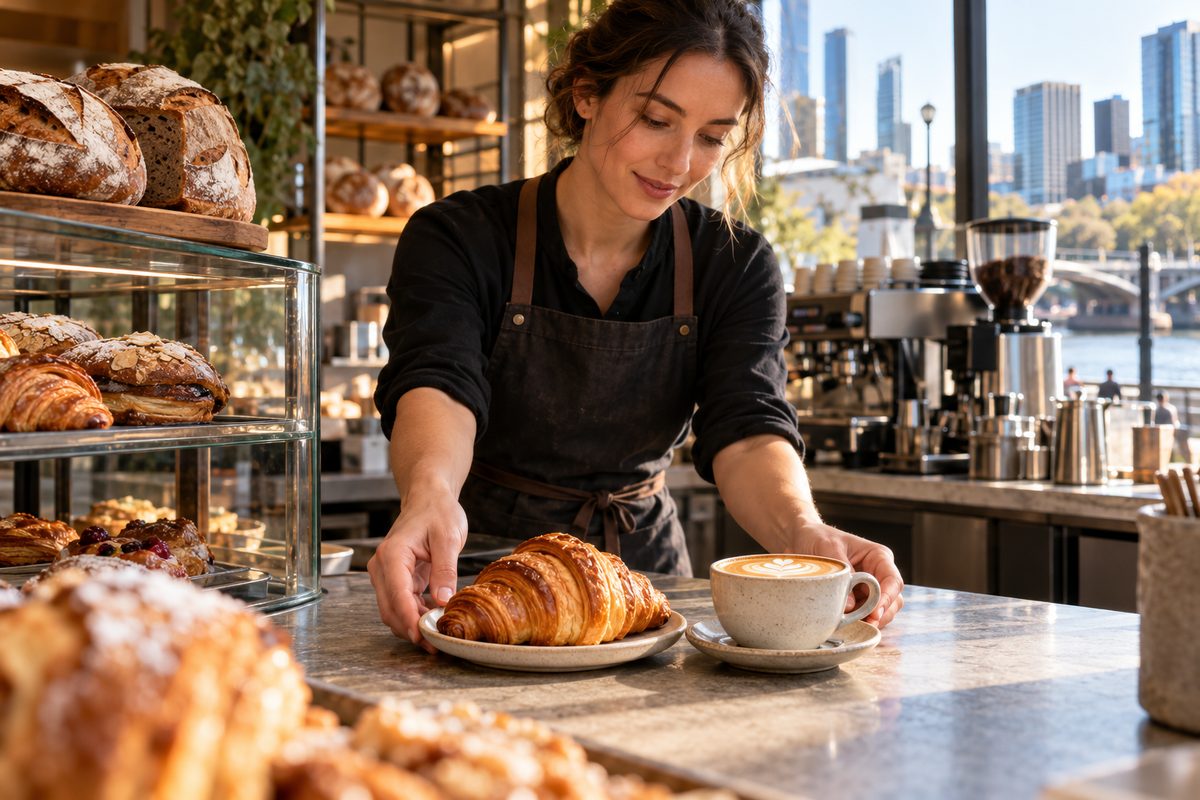
Southbank Melbourne Bakery Cafes
The best Southbank Melbourne bakery cafes bake on site, sell out by early afternoon and sit away from the busiest stretch of the riverfront. If you want flaky pastry and good coffee, you'll do better at a shop with a small menu and a visible oven than at a big promenade venue with a glass cabinet of trucked-in croissants. This guide from Southbank by the River shows you how to pick a bakery cafe by where you are and why you're out. It also covers when to arrive and what to order to test a place fast.
Opening hours and menus change often. Check a venue's own website or social page on the day before you make a special trip.
What makes a real bakery cafe different from a cafe that sells pastries?
A real bakery cafe makes its own dough. A cafe that sells pastries buys them in, often from a large wholesale bakery that supplies dozens of shops across Melbourne. Both can serve a decent croissant. Only one can serve it an hour out of the oven.
This matters more for pastry than for almost any other food. Laminated dough, the kind with thin layers of butter folded through, is at its best for a few hours after baking. After that the butter softens, the layers go limp and the crunch fades. A croissant baked at 5am and sold at 3pm is a different product from one sold at 9am.
Here are the signs that a place bakes on site:
- You can see ovens, a bench or trays cooling behind the counter.
- The range is small and changes by day or season.
- Items sell out, and staff say so without fuss.
- Pastries vary a little in shape and colour from tray to tray.
Perfectly identical pastries in neat rows, plus a huge range that never runs out, usually point to a supplier. That's fine for a quick bite. It's not worth crossing the river for.
Where do bakery cafes cluster in Southbank?
Southbank, Victoria is a dense mix of apartment towers, offices, arts venues and riverside dining. The bakery scene follows the people. Each pocket has a different feel, so start with where you'll be.
The riverfront and Crown Melbourne end
The Southbank Promenade along the Yarra River gets the most foot traffic in the suburb. Near Crown Melbourne, most food venues aim at visitors, diners and hotel guests. You'll find pastries here, but many cabinets are stocked for volume rather than craft.
The upside is the setting. A coffee and a pastry on a bench facing the river and the city skyline is hard to beat. If the view is the point, buy here. If the pastry is the point, walk a few blocks inland first and bring it back to the water.
The Melbourne Arts Precinct
The Melbourne Arts Precinct runs along St Kilda Road and the streets behind it. Arts Centre Melbourne, Hamer Hall, Melbourne, the National Gallery of Victoria and the Australian Centre for Contemporary Art all sit within a short walk. Cafes here serve gallery visitors by day and theatre crowds before evening shows.
Arts Centre Melbourne runs its own food and drink outlets, and these change with programming. Check the Arts Centre Melbourne website for what's open on show days. For a proper bakery stop before a matinee, the side streets toward Southbank Boulevard and Sturt Street are worth a look.
Inner Southbank residential streets
The quieter blocks behind the main boulevards are where locals buy their morning loaf. These shops open early for residents and office workers, then slow down after lunch. They tend to have the best value and the least crowding. Many close earlier on weekends or shut on one weekday, so check before you go.
South Melbourne Market
South Melbourne Market sits a short walk or tram ride south-west of Southbank. It has several bakery and pastry stalls under one roof, so you can compare a few in one visit. The market trades on set days each week, usually Wednesday, Friday, Saturday and Sunday. Confirm current trading hours on the official South Melbourne Market website before heading over.
Go early. Popular pastry stalls at the market can sell out of their best items well before noon on a Saturday.
When should you go for the freshest pastry?
Arrive between about 8am and 10am on a weekday for the best pastry with the shortest queue. Most on-site bakers pull their first trays very early, then bake a second round mid-morning. That window gives you warm stock without the weekend rush.
Here is how a typical day plays out at a busy bakery cafe:
- Opening to 8am: Commuters and residents. Fast service, full shelves, takeaway focus.
- 8am to 10am: The sweet spot. Fresh trays, seats come free as commuters leave.
- 10am to 1pm: Brunch crowds on weekends. Queues grow and favourites start to disappear.
- After 2pm: Thin shelves. What's left is often from the morning bake.
Weekends shift the curve later and make it steeper. Sunday mornings in the arts end can be busy with gallery visitors, while weekday mornings fill with office workers from the Melbourne central business district crossing the river.
One angle most guides miss: a late-afternoon visit can still pay off for bread and savoury bakes. Sourdough holds up for a day or more, and pies and rolls are often reheated to order. It's only the delicate pastries that suffer after lunch.
What should you order to test a bakery cafe?
Order two items: one sweet, one savoury. Together they tell you almost everything about the kitchen.
The pain au chocolat test
A good pain au chocolat shatters when you bite it and leaves flakes on your plate. Cut it in half and look inside. You want a honeycomb of open layers with dark chocolate batons running through. A dense, bready middle means the dough was rushed or the butter was poor.
The pain au chocolat is a better test than a plain croissant. It's harder to hide flaws, because the chocolate adds weight and the dough has to hold up around it.
The sausage roll test
The sausage roll is the savoury standard in Australian bakeries. A good one has crisp, golden pastry all the way round, including the base. The filling should be juicy and well seasoned, with no pool of grease underneath. A soggy bottom means it sat too long or was reheated badly.
Many bakery cafes add their own twist, such as fennel, apple or chilli. That's a good sign. It means someone in the kitchen is making choices rather than opening a box.
The flat white
Pair your pastry with a flat white. It's the most ordered coffee in Melbourne, so every barista makes hundreds. If they can't get it right, nothing else on the coffee menu will save them. Look for smooth, glossy milk with fine texture and no big bubbles, and coffee that tastes rich without burning.
How do you judge the coffee before you order?
Melbourne coffee culture sets a high bar, and bakery cafes sit at both ends of it. Some put as much care into coffee as into dough. Others treat coffee as an add-on to the pastry case.
Look for these clues as you walk in:
- A named roaster. Bags on the shelf or a sign naming who roasts the beans shows the owners care where their coffee comes from.
- A filter or single-origin option. This points to a specialty coffee focus, where beans are bought for their flavour and roasted lighter.
- Staff who weigh shots. Scales on the machine mean the barista is measuring rather than guessing.
- A clean steam wand. A crusty wand means sloppy milk and a bitter edge.
Specialty coffee and laminated pastry go well together. Lighter roasts have a bright, fruity taste that cuts through butter. If you like a strong, dark coffee with your pastry, ask for the house blend instead of the single origin.
What if you follow a gluten-free diet?
A gluten-free diet is the hardest fit for a bakery cafe, because flour is everywhere. Even when a shop sells gluten-free items, flour dust in the air and on shared benches can be a problem for people with coeliac disease.
Ask these questions before you order:
- Is the item made on site or bought in from a dedicated gluten-free bakery?
- Is it stored and served separately from wheat products, with its own tongs?
- Is it labelled as gluten-free, or only as "made without gluten ingredients"?
Items bought in from a dedicated gluten-free supplier and kept sealed are often the safer pick. A gluten-free cake made on the same bench as croissants carries more risk. If you have coeliac disease, Coeliac Australia keeps guidance on eating out that's worth reading before your visit.
The good news is that most bakery cafes in Southbank serve gluten-free options on the cafe side of the menu, such as eggs, salads and toast on gluten-free bread. You can still enjoy the coffee and the setting while skipping the pastry case.
How do you match a bakery cafe to your plans?
The right choice depends on what else you're doing that day. Here's how to pick by occasion.
Coming in from Flinders Street railway station
Flinders Street railway station is a short walk across Princes Bridge to Southbank. If you're arriving by train, grab takeaway on the way and eat by the river. The bridge end of the promenade has plenty of seating facing the city. Keep it quick and simple: a coffee and one pastry in a paper bag.
Before a show at Hamer Hall or the State Theatre
For a matinee or early concert, plan a bakery stop about an hour before curtain. Cafes in the arts end can fill fast on show days. A savoury bake works better than a sweet one here, because it'll hold you through a long performance. Check what Arts Centre Melbourne has open on the day, as venue outlets often open only around performance times.
A slow weekend morning
This is the time to sit down and stay. Head to a quieter residential street or make the trip to South Melbourne Market. Order more than you'll finish and take the rest home. Day-old pastry can be refreshed in a hot oven for four or five minutes.
Meeting someone visiting Crown Melbourne
If you're meeting friends staying near Crown Melbourne, a riverfront cafe makes sense for the view and the easy meeting point. Pick one with outdoor seating and keep your expectations on the pastry modest. Or suggest a short walk inland, then carry your bag back to the water.
A work coffee near the CBD
Southbank's office towers sit close to the Melbourne central business district. A bakery cafe on the Southbank side of the river is often calmer than its CBD equivalents for a quick meeting. Go before 8am or after 10am to avoid the commuter rush at the counter.
Your next steps
Pick your bakery cafe by where you'll be and what you want most, then arrive early enough to get it fresh.
- Decide whether you want the view or the pastry. If it's the pastry, walk inland from the promenade first.
- Aim for a weekday between 8am and 10am, or arrive at opening on weekends.
- Look for ovens, a short menu and a named coffee roaster before you queue.
- Order a pain au chocolat and a sausage roll to test the kitchen in one visit.
- Pair them with a flat white to judge the barista.
- If you eat gluten-free, ask how items are made and stored before ordering.
- Check opening days and hours on the venue's own website or, for the market, the official South Melbourne Market site.
For more ways to plan your time along the river, explore the rest of Southbank by the River.